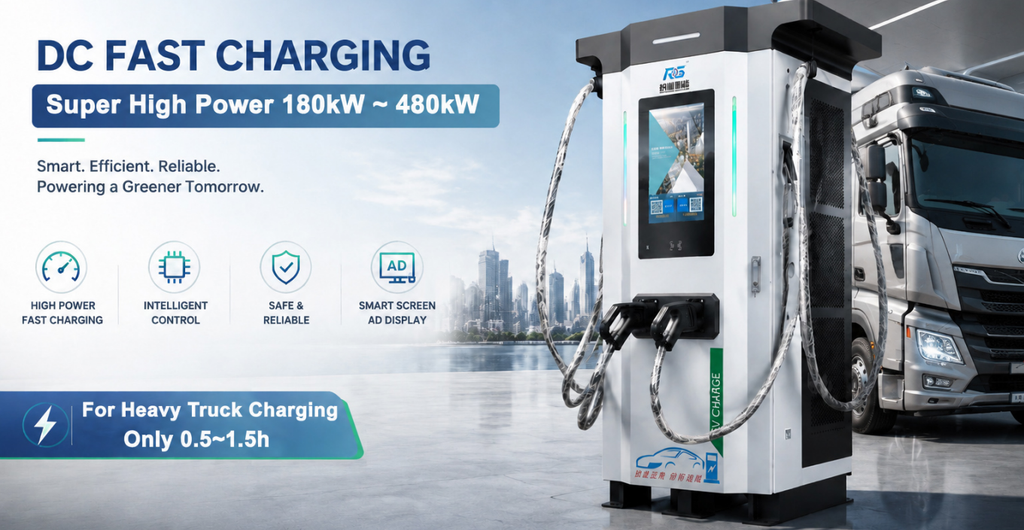
The rapid development of electric commercial vehicles is creating new demands for high-power charging infrastructure. Compared with passenger cars, heavy-duty electric trucks typically have larger battery capacities, higher energy consumption, and more demanding operating schedules. As a result, their charging requirements are significantly different.
For logistics companies, fleet operators, truck manufacturers, and commercial charging station developers, choosing the right charging equipment is essential to keeping vehicles on the road and maintaining operational efficiency.
A high-power DC charger is an important part of the solution, but selecting the right equipment requires more than looking at its rated power. Output voltage, charging current, vehicle compatibility, connector configuration, cable management, and available grid capacity must all be considered.
In this article, we explore the key requirements for heavy-duty electric truck charging and explain how to plan a suitable high-power DC charging solution.
1. Why Do Heavy-Duty Electric Trucks Need High-Power Charging?
Heavy-duty electric trucks are commonly used in logistics, freight transportation, mining, ports, construction, and other commercial applications.
Unlike passenger vehicles, these trucks often operate for extended periods and need to carry out demanding transportation tasks. Long charging times may affect vehicle availability and daily transportation schedules.
Several factors make high-power charging particularly important:
Larger battery capacity
Heavy-duty electric trucks generally have larger battery packs than passenger cars. More energy is therefore required to recharge them.
High daily energy consumption
Long-distance transportation, heavy loads, and frequent operation can result in substantial daily energy demand.
Limited charging time
Logistics and transportation companies often operate according to strict delivery schedules. Charging equipment needs to provide sufficient energy within the available parking or rest periods.
Multiple vehicles charging at the same location
Fleet depots and logistics centers may need to charge several trucks simultaneously, creating significant demand for electrical power.
For these applications, high-power DC charging can help reduce charging time and improve fleet utilization, provided that the vehicles and site infrastructure support the required charging power.
2. Charging Power: How Much Power Does an Electric Truck Need?
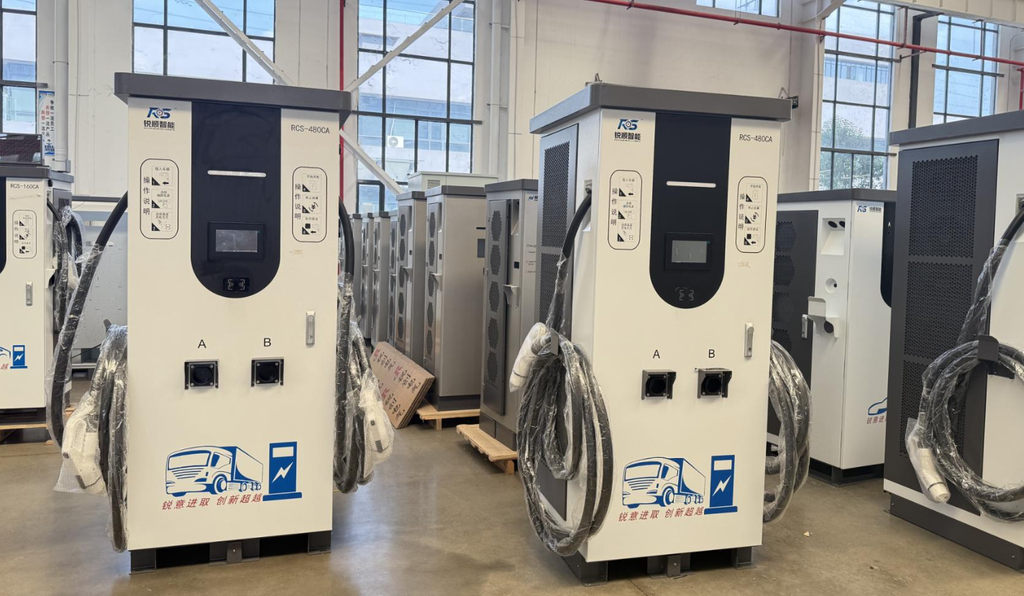
Charging power is one of the first specifications to consider when selecting a DC charger for heavy-duty electric trucks.
The required power depends on battery capacity, daily energy consumption, available charging time, and the vehicle's maximum charging capability.
The following table provides a general reference for different charging applications.
| DC Charging Power | Potential Applications | Main Considerations |
|---|---|---|
| 60–120 kW | Smaller electric commercial trucks and depot charging | Suitable when longer charging periods are available |
| 120–240 kW | Medium- to heavy-duty electric trucks | A balance between charging speed and infrastructure requirements |
| 240–400 kW | High-utilization heavy-duty truck fleets | Higher output requirements and stronger electrical infrastructure |
| Above 400 kW | Specialized high-power charging applications | Requires compatible vehicles and carefully designed charging systems |
These power ranges are indicative rather than universal vehicle requirements. Actual charging performance depends on the truck's battery system, charging interface, battery management system, and operating conditions.
For example, a 400 kW charger does not automatically mean that every connected truck can receive 400 kW. The vehicle must support the corresponding charging voltage and current, and its battery management system must permit that charging rate.
The key is to match charger power with vehicle capability and actual operating requirements.
3. Output Voltage and Charging Current: Two Critical Factors
When selecting a high-power DC charger for electric trucks, output voltage and current are just as important as rated power.
DC charging power is calculated using the following relationship:
Power (kW) = Voltage (V) × Current (A) ÷ 1,000
For example:
- 600 V × 500 A = 300 kW
- 800 V × 500 A = 400 kW
- 1,000 V × 400 A = 400 kW
These examples illustrate how different voltage and current combinations can deliver the same rated power.
However, the charger's voltage range must match the vehicle's battery voltage requirements, and its maximum output current must be sufficient to deliver the intended charging power.
Why does this matter?
Imagine a high-power DC charger with a rated output of 400 kW. If the vehicle's battery voltage is relatively low, the charger may need to provide higher current to achieve the same power output.
If the charger's maximum current is insufficient, the actual charging power will be lower than its rated capacity.
For this reason, before purchasing a high-power charger, confirm:
- Vehicle battery voltage range
- Maximum permitted DC charging current
- Maximum vehicle charging power
- Charger output voltage range
- Charger maximum output current
- Compatibility between the charger and vehicle charging interface
For fleet operators with different truck models, checking the compatibility of every vehicle type is especially important.
4. Dual-Gun Charging: Is It Suitable for Heavy-Duty Truck Fleets?
For large charging stations and fleet depots, dual-gun DC chargers can provide greater charging flexibility.
A dual-gun charger has two charging connectors, allowing two vehicles to connect to the same charging unit.
However, it is important to understand how the charger distributes its available power.
There are generally two considerations:
Simultaneous charging capability
Some dual-gun chargers support charging two vehicles simultaneously, while others may support only one active charging session at a time. This depends on the equipment design.
Power distribution between connectors
When two vehicles charge simultaneously, the available output power may be shared between the two connectors.
For example, a 400 kW charger may support different power distribution arrangements depending on its design and the connected vehicles' requirements.
If the charger has a shared 400 kW output capacity, it does not necessarily provide 400 kW to each connector simultaneously.
Before selecting a dual-gun configuration, ask the manufacturer:
- Can both connectors operate simultaneously?
- What is the maximum output power of each connector?
- Is power dynamically allocated between vehicles?
- Can power distribution be configured according to project requirements?
For commercial fleet operators, dual-gun charging can help improve equipment utilization and reduce the number of individual charging units required in some layouts.
However, the actual benefits depend on charging schedules, vehicle compatibility, and the site's total available power.
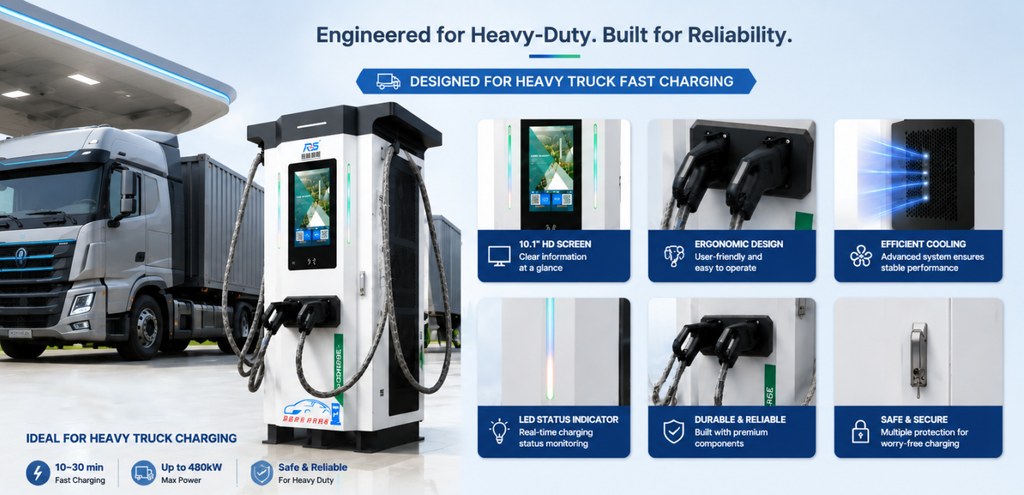
5. Cable Management: An Important Detail in Heavy-Duty Charging
Charging cables are often overlooked during equipment selection, but they have a significant impact on the daily operation of heavy-duty charging stations.
Compared with passenger car charging, truck charging environments may involve larger parking spaces, higher vehicle positions, and different connector access points.
Cable management should therefore be considered during the equipment design and site planning stages.
Important factors include:
Cable length and positioning
The cable should be long enough to reach the vehicle charging inlet without creating unnecessary tension or restricting parking arrangements.
Cable weight and handling
High-current charging cables can be heavy and difficult to handle. A suitable cable management system can help reduce the physical effort required from operators.
Cable protection
Charging cables should be protected against vehicle movement, ground contact, accidental impact, and excessive bending.
Cable storage
Cable storage or management systems can help keep charging areas organized and reduce unnecessary wear during daily operation.
For high-power applications, liquid-cooled charging cables may also be considered when the required current exceeds the practical capability of conventional cable designs.
The appropriate solution depends on charging current, operating environment, cable length, and equipment configuration.
6. Grid Capacity and Power Distribution for Truck Charging Stations
Installing high-power DC chargers requires careful evaluation of the site's electrical infrastructure.
A charging station with multiple 300 kW or 400 kW chargers can create substantial electricity demand.
For example, four 400 kW chargers have a combined rated DC output capacity of 1,600 kW when all operate at full power.
This does not mean every site needs exactly 1,600 kW of grid capacity, because actual demand depends on charger efficiency, simultaneous charging requirements, power management, and other site loads. However, it demonstrates why electrical planning is essential.
Before installation, evaluate the following:
Transformer capacity
Determine whether the existing transformer can support the planned charging load. If not, transformer upgrades or a new grid connection may be necessary.
Power distribution system
The distribution cabinet, circuit breakers, cables, and protection devices must be appropriately selected for the expected electrical load.
Dynamic load management
For sites with multiple chargers, a power management system can distribute available power according to vehicle charging demand and operational priorities, where supported.
Future expansion
If the fleet is expected to grow, reserve sufficient space and consider future electrical capacity during the initial site design.
Proper electrical planning helps prevent unexpected infrastructure costs and supports reliable charging station operation.
7. Charging Standards and Vehicle Compatibility
Different electric truck manufacturers and markets may use different charging interfaces and communication requirements.
Before purchasing charging equipment, confirm that the charger supports the standards required by the target vehicles and local market.
Key considerations include:
- Charging connector type and regional standards
- DC output voltage and current range
- Communication protocol between the charger and vehicle
- Vehicle battery management system compatibility
- Applicable product certifications and electrical safety requirements
For heavy-duty electric trucks, charging infrastructure may use CCS-based systems or higher-power charging technologies such as the Megawatt Charging System (MCS), depending on the vehicle, market, and project requirements.
It is important to note that MCS and conventional CCS charging are not interchangeable simply because both are DC charging systems. Connector, communication, electrical, and vehicle compatibility must be verified.
When planning an international charging project, discuss the target market and vehicle specifications with the charger manufacturer before confirming the equipment configuration.
8. How to Plan a High-Power Charging Station for Heavy-Duty Trucks
A successful heavy-duty truck charging project starts with understanding the actual transportation and charging requirements.
Here are five practical steps.
Step 1: Identify the vehicle types
Determine whether the charging station will serve electric tractors, delivery trucks, dump trucks, buses, or other commercial vehicles.
Different vehicles may have different battery voltages, charging interfaces, and maximum charging powers.
Step 2: Calculate daily energy demand
Estimate the number of trucks, average daily mileage, energy consumption, and required charging frequency.
This helps determine the total energy demand and the number of charging units required.
Step 3: Determine the available charging time
Understand when vehicles are available for charging.
A fleet that charges overnight may have different requirements from one that needs fast charging during short operational breaks.
Step 4: Evaluate electrical infrastructure
Check available grid capacity, transformer specifications, distribution equipment, and possible infrastructure upgrades.
Step 5: Select the right charger configuration
Based on the previous information, determine the required power rating, voltage range, current capacity, connector configuration, cable management system, and optional functions.
This approach helps avoid choosing equipment based solely on its rated power.
9. Why Choose a High-Power DC Charger from Risen?
For heavy-duty electric truck charging projects, equipment reliability, output performance, and configuration flexibility are important considerations.
Risen provides DC EV charging equipment for commercial and high-power charging applications, including configurations designed for heavy-duty vehicle charging.
Our high-power charging solutions can be evaluated according to project requirements, including:
- High-power DC charging configurations, including 400 kW options
- Dual-gun charging configurations
- Output voltage and current specifications matched to vehicle requirements
- Optional cable management solutions
- Configurable equipment features for different charging applications
- Technical support for equipment selection and project requirements
Whether you are developing a truck charging depot, a logistics center, or a commercial high-power charging station, selecting equipment that matches your vehicles and site conditions is essential.
Our team can help you evaluate the appropriate charging equipment based on your project specifications.
10. Request a High-Power DC Charger Solution for Your Truck Fleet
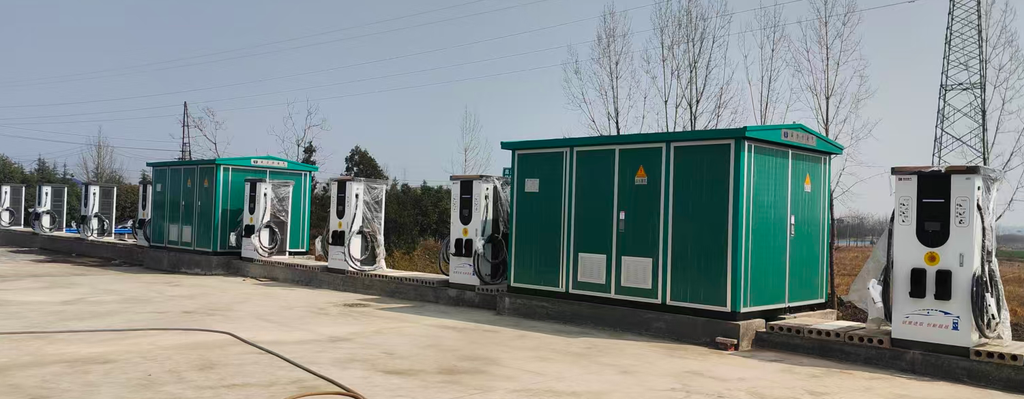
Planning a charging station for electric heavy-duty trucks?
To help us recommend suitable charging equipment, please share the following information:
- Project country: Where will the charging equipment be installed?
- Vehicle type: Electric tractor trucks, delivery trucks, dump trucks, or other commercial vehicles?
- Required charging power: 200 kW, 300 kW, 400 kW, or another specification?
- Vehicle battery voltage: What is the battery voltage range?
- Charging connectors: CCS1, CCS2, MCS, or another standard?
- Quantity: How many charging units do you need?
- Charging configuration: Single-gun or dual-gun?
- Available power supply: What is the site's available electrical capacity?
If you do not have all the technical specifications yet, simply share your vehicle model and project requirements. Our team can help identify the key information needed for equipment selection.
Contact Risen today to discuss your heavy-duty electric truck charging project and request a high-power DC charger quotation.